🎵 “ABC” – EOA and The OTHER A’s of Alzheimer’s (Jackson 5)
Just when I thought I had learned the Four A's of Alzheimer's...
Apparently Alzheimer's said:
Hold my beer.
Because there are more.
A LOT more.
Depending on which dementia educator, healthcare organization or caregiver resource you're reading, you may see references to the Four A's, Five A's, Seven A's, Eight A's and probably seventeen A's by the time I finish writing this.
So let's go back to school.
🎵 ABC... easy as 1, 2, 3...
Except nothing about Alzheimer's is easy.
🧠 First: There Isn't One Official List
Before we start, this is important.
“The A's of Alzheimer's” isn't an official staging system or a single universally accepted medical checklist.
It's a teaching tool.
Different dementia organizations use different A-words to help families understand the cognitive, behavioral and neurological changes that can occur with dementia.
Some terms are actual neurological conditions.
Others are useful ways dementia educators group symptoms together.
Either way, they can help us put names to some of the incredibly strange things we're watching happen.
And sometimes knowing why something is happening changes how we respond to it.
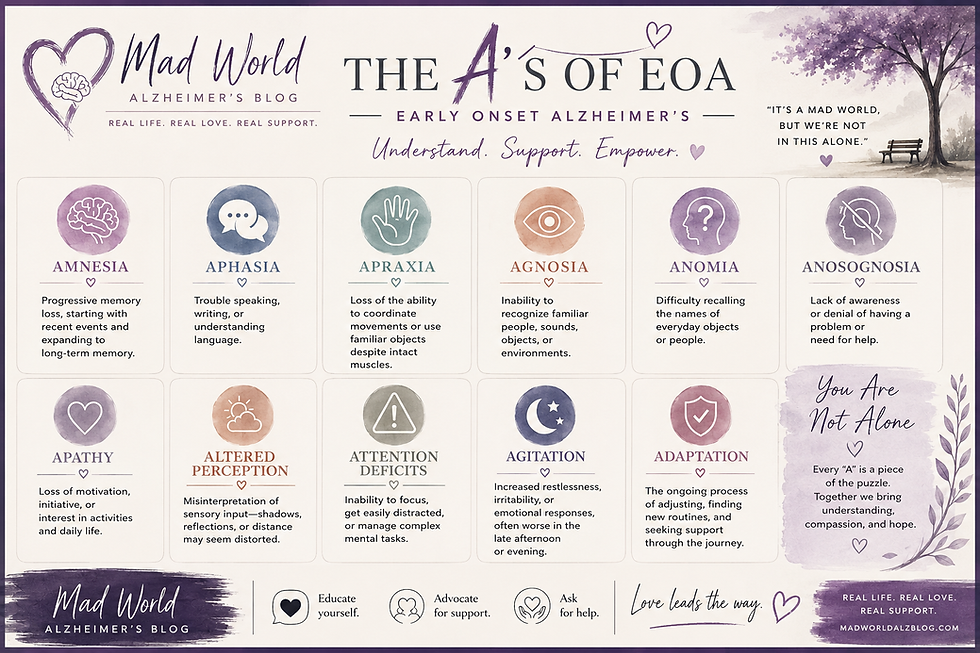
🧠 AMNESIA
“I don't remember that.”
Think: MEMORY.
This is the Alzheimer's symptom everyone expects.
But even memory loss isn't as simple as forgetting things.
Early on, newer memories are often particularly vulnerable.
You can have a conversation...
And five minutes later:
“You never told me that.”
Yes.
I did.
Six times.
But here's the part caregivers have to learn:
For them, it may genuinely be the first time they're hearing it.
Meanwhile, they may tell you a detailed story from 1987.
That's because different kinds of memory can be affected differently as Alzheimer's progresses.
💜 What can help?
Stop testing.
Instead of:
“Don't you remember?”
Just give them the information again.
Use calendars. (Also a monthly dry erase and we cover the days)
Whiteboards. (We love our dry erase white board)
Pictures.
Labels. (Small post it's everywhere)
Routines.
And sometimes simply answer the same question for the seventh time.
Trust me.
I know.
🗣️ ANOMIA
“Give me the...the...you know...THING.”
Think: NAMES.
Anomia is difficulty retrieving the names of familiar things.
They may know exactly what something is.
They may know exactly what it does.
But their brain can't retrieve its name.
The refrigerator becomes:
“The cold thing.”
The remote becomes:
“The TV thing.”
A toothbrush becomes:
“The thing for my teeth.”
Sometimes people's names disappear too.
That doesn't necessarily mean your spouse doesn't recognize the person.
They may simply be unable to retrieve their name.
💜 What can help?
Give them time.
Then gently offer the word.
“Do you mean the remote?”
What I try NOT to do is:
"Come on...you know this. What's it called?"
This isn't Jeopardy.
They don't need to prove they know it.
They need help getting the word.
💔 APATHY
“I just don't want to do anything.”
Think: MOTIVATION.
This one can look like:
Laziness.
Depression.
Stubbornness.
Or simply not caring anymore.
The person who used to exercise every morning...
Doesn't.
The person who worked constantly...
Sits.
The person who loved going places...
Never suggests going anywhere.
Apathy can involve loss of motivation, initiative and interest.
The important distinction is:
It may not be:
“I don't WANT to.”
The brain may be struggling to generate the motivation required to START.
💜 What can help?
I've learned that asking:
“What do you want to do today?”
may accomplish absolutely nothing.
Instead:
“Let's go for a walk.”
Shoes out.
Water bottle ready.
We're going.
Sometimes starting the activity for them is the difference.
And significant or sudden changes should always be mentioned to the doctor because depression, medications, illness, sleep problems and other conditions can look similar.
👁️ ALTERED PERCEPTION
“That's not what MY brain sees.”
Think: INTERPRETATION.
Here's another strange one.
Their eyes may be working perfectly well.
But their brain may not interpret what they're seeing correctly.
A black rug can look like a hole.
A shiny floor can look wet.
A shadow can look like a person.
Busy carpeting can become confusing.
Steps may become difficult to judge.
Mirrors can eventually cause confusion.
Suddenly you start understanding why your spouse is:
Walking around something that isn't there.
Refusing to cross a particular floor.
Staring at a shadow.
Or behaving strangely around a mirror.
💜 What can help?
Look at your house differently.
Reduce glare.
Improve lighting.
Remove unnecessary rugs.
Avoid extremely busy patterns.
Use helpful contrast.
Keep walkways clear.
And don't argue with what they're seeing.
Their brain is telling them it's real.
Reassure.
Redirect.
Move on.
🎯 ATTENTION DEFICITS
“There's too much happening.”
Think: FOCUS.
This one explains SO MUCH about restaurants.
Imagine:
Music.
Twenty conversations.
Plates clattering.
Someone walking behind you.
A television playing.
A server suddenly asking:
"Would you like soup or salad and what dressing would you like and do you want another drink?"
And then we wonder why our person just stares at them.
The Alzheimer's brain can increasingly struggle with maintaining attention, shifting attention and processing multiple pieces of information.
What feels normal to us can become complete sensory overload.
💜 What can help?
One thing at a time.
One question.
One direction.
One choice.
Instead of:
“What do you want to eat?”
Try:
“Burger or chicken?”
Instead of:
“Go upstairs, shower, shave, brush your teeth and get dressed.”
Start with:
“Let's take a shower.”
Then deal with Step Two.
🧠 Now Put Them Together
Here's where Alzheimer's gets tricky.
Imagine your spouse standing in the bathroom.
They're holding a toothbrush.
🧠 Amnesia:
Why am I in here?
🗣️ Anomia:
What's this thing called?
👀 Agnosia:
What IS this thing?
👕 Apraxia:
How do I use it?
🗣️ Aphasia:
I can't explain what's wrong.
🧠 Anosognosia:
There's nothing wrong with me. I don't need help.
🎯 Attention:
And please stop giving me six instructions at once.
💔 Apathy:
And honestly, I don't want to do this anyway.
And I'm standing in the doorway thinking:
FOR THE LOVE OF GOD, JUST BRUSH YOUR TEETH.
See the problem?
😂
❤️ The Labels Aren't Really the Important Part
I'm probably never going to remember every neurological term.
And frankly, I don't need another degree.
What these words have given me is something more useful:
Perspective.
Instead of immediately thinking:
Why won't he do this?
I'm learning to ask:
What part of this is difficult for his brain?
Does he understand my words?
Does he recognize the object?
Does he remember what he's supposed to do?
Can he sequence the movements?
Is there too much happening around him?
Does he understand that he needs my help?
That's a completely different way of looking at Alzheimer's behavior.
And sometimes changing my approach works better than trying to change his.
🎓 Your Alzheimer's ABC Cheat Sheet
🧠 AMNESIA = MEMORYI don't REMEMBER it.
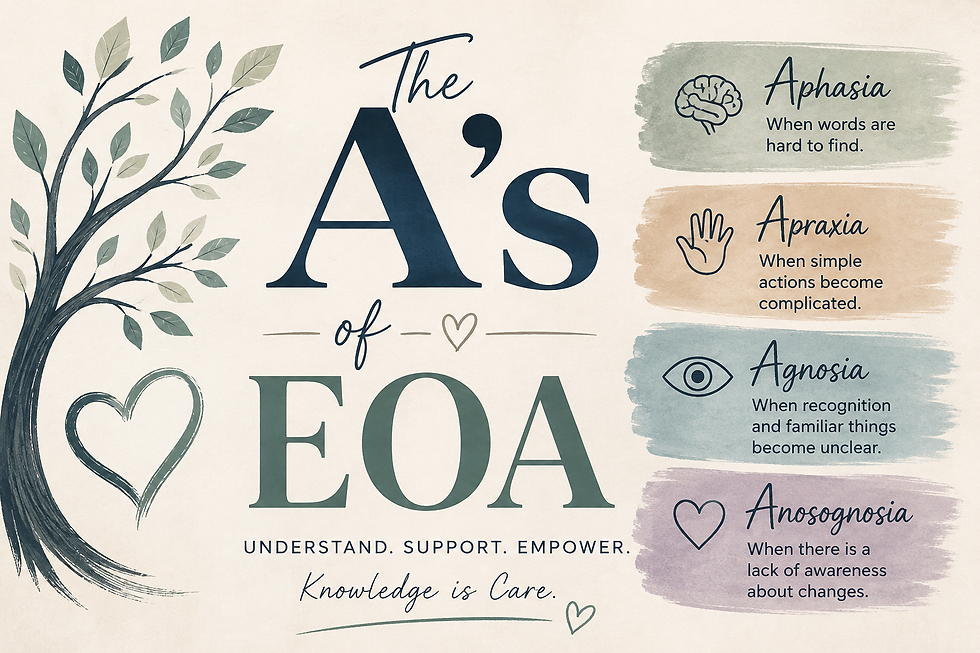
🗣️ APHASIA = LANGUAGEI can't SAY or understand it.
👕 APRAXIA = ACTIONI can't DO it.
👀 AGNOSIA = RECOGNITIONI don't KNOW what it is.
🧠 ANOSOGNOSIA = AWARENESSI don't KNOW that I can't.
🗣️ ANOMIA = NAMESI know it, but I can't NAME it.
💔 APATHY = MOTIVATIONI can't get myself to START.
👁️ ALTERED PERCEPTION = INTERPRETATIONMy brain isn't interpreting what I see correctly.
🎯 ATTENTION DEFICITS = FOCUSI can't process everything happening at once.
🎵 Why “ABC”
Because apparently caring for someone with Alzheimer's means going back to school.
Except instead of:
A, B, C...
We're learning:
Aphasia.
Apraxia.
Agnosia.
Anosognosia.
Amnesia.
Anomia.
Apathy.
And a bunch of other words I definitely didn't know I needed.
I didn't sign up for this class.
Neither did you.
But understanding what's happening inside that damaged brain has made some of the things happening outside of it a little easier for me to understand.
And maybe that's the real lesson.
Sometimes they're not being difficult.
Sometimes they're having difficulty.
There's a huge difference.
🎓 Class dismissed.
Until Alzheimer's gives us another pop quiz tomorrow.
💜 Caregiver Question
Which “A” made something suddenly click for you?
Was there something your person was doing that drove you crazy until you finally understood what might actually be happening in their brain?
💬 Disclaimer-
Keep in mind, I am writing this blog over years, not in one day- I repeat some things, but because it became more applicable today.
I’m not a doctor, lawyer, therapist, or expert—just a wife trying to figure this out one day at a time. Everything shared here is based on our experience and things that have helped us along the way. Take what helps, leave what doesn’t, and always check with professionals when needed. I also use AI to help clean up my writing, organize thoughts, and pull together resources because honestly… caregiver brains are tired too. If something here helps another family feel less alone, then it’s worth sharing.


Comments