🎵 “Hot for Teacher” –EOA The A’s of Alzheimer’s (VanHalen)
Updated: Aug 22
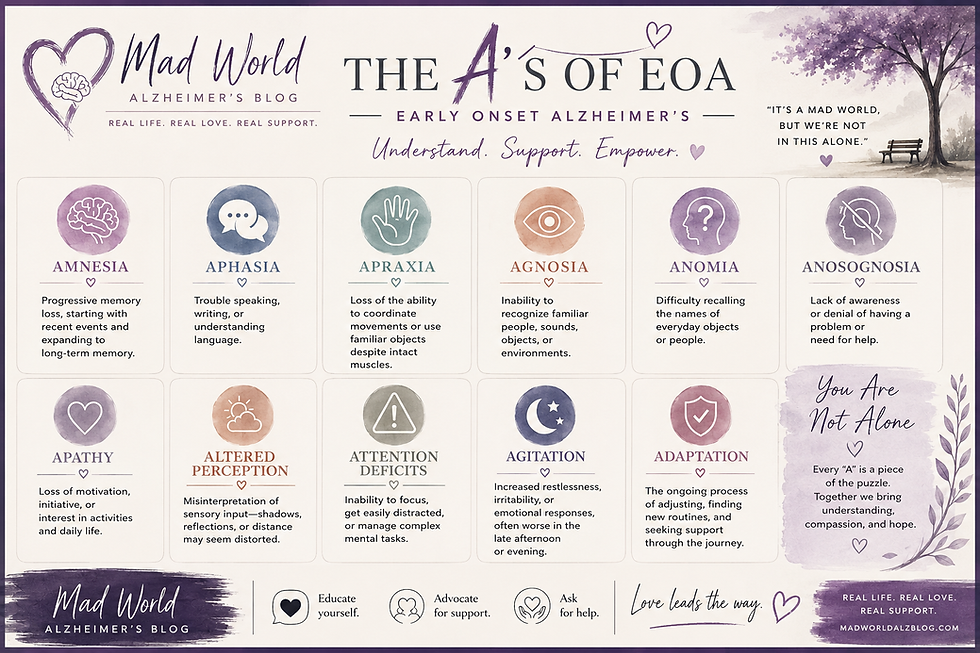
We are heading back to school....
Definitely no summer break.
And somehow we're expected to learn an entirely new vocabulary while simultaneously taking care of someone we love.
Four words I wish someone had explained to me much earlier are:
Aphasia.
Apraxia.
Agnosia.
Anosognosia.
They are referred to as The A's of Alzheimer's or Dementia and there are more than these....
--I will bring them in next post- because you see them, regardless and sometimes don't even know it.
They sound similar.
They can happen at the same time.
And from the outside, they can look like your spouse is confused, being stubborn, ignoring you, or simply doing something completely bizarre.
But once you understand what each one means, some of those strange Alzheimer's moments start making a little more sense.
So class is officially in session.
🗣️ A #1: APHASIA
“I know what I want to say...but I can't get it out.”
Think: WORDS & LANGUAGE.
Aphasia affects a person's ability to communicate.
That can include both speaking and understanding language, as well as reading and writing.
Early on, it might be subtle.
Your spouse can't find a word.
They know exactly what they're looking at, but instead of saying:
“Refrigerator.”
You get:
"The...the...you know...the cold thing...where the food goes."
Then substitutions may start.
A watch becomes a clock.
A fork becomes a spoon.
Your daughter becomes your sister.
Sometimes they'll create a word that doesn't exist.
And sometimes you'll get an entire sentence of words that individually make sense but together make absolutely no sense at all.
People often call that “word salad.”
Here's the important part:
Don't assume there's no thought behind the words.
There may be a perfectly reasonable thought trapped inside a brain that can no longer reliably turn that thought into language.
That's why you sometimes see the frustration on their face.
They know they're trying to tell you something.
They just can't get you there.
💜 What can help?
Give them time.
Don't immediately correct every wrong word.
Offer a word if they're clearly looking for it:
“Are you thinking of the refrigerator?”
Use gestures.
Point.
Show them the object.
Ask simple either/or questions instead of open-ended questions.
And sometimes...
stop talking.
Our instinct is to explain more when someone doesn't understand us.
With Alzheimer's, more words can sometimes make things worse.
👕 A #2: APRAXIA
“I know what I'm supposed to do...but I can't make the steps work.”
Think: ACTION.
This is the one that recently smacked me right in the face at the beach.
Rob wanted to put on his sun shirt.
His arms worked.
He could hold the shirt.
He knew it went on his body.
But suddenly...
One arm was through the sleeve.
The other was through the hood.
That can be apraxia.
The brain has difficulty planning and carrying out a familiar learned movement even though the person may still physically be capable of doing it.
And once you know what you're looking for, you may start recognizing it everywhere.
It can show up when someone tries to:
Put clothing on correctly
Brush their teeth
Shave
Tie their shoes
Use utensils
Operate their phone
Turn on the shower (or shut off the shower)
Use familiar household objects
Follow the steps of a familiar task
This is why someone can be physically incredibly fit and still struggle to put on a shirt.
The muscles aren't necessarily the problem.
The instructions coming from the brain are.
💜 What can help?
Break things into one step at a time. Get rid of the difficult things.
Instead of:
"Go take a shower, wash your hair, shave and get dressed."
Try:
“Let's take a shower.”
Then deal with the next step when you get there.
Lay clothes out in order.
Simplify products. (if hooded shirts are an issue, donate time)
Remove unnecessary choices.
Demonstrate instead of explaining.
And most importantly...
Don't rush in too quickly.
If it's safe, let them try.
Sometimes maintaining independence means accepting that something may take ten minutes instead of two.
👀 A #3: AGNOSIA
(Phonetic: ag-NOH-zee-uh_
“I'm looking right at it...but I don't know what it is.”
Think: RECOGNITION.
This one can be particularly difficult for families.
Agnosia is difficulty recognizing or interpreting familiar sensory information even though the sensory system itself may still work.
Their eyes can see.
But the brain may not correctly identify what the eyes are seeing.
That could be an object.
A place.
A sound.
And sometimes...
a person.
Your spouse may look at something they've used for decades and not understand what it is.
They may not recognize their house as home.
They may look into a mirror and become confused by the person looking back.
And eventually, some people may have difficulty recognizing people they have loved for decades.
That's one of the cruelest parts of this disease.
But there's something I think caregivers need to remember:
Recognition and emotional connection aren't necessarily the same thing.
Your spouse may someday struggle to retrieve:
“That's my wife.”
But they may still recognize:
You're safe.
You're familiar.
I trust you.
Sometimes the feeling survives longer than the label.
🧠 A #4: ANOSOGNOSIA
(Phonetic: uh-no-sog-NOH-zee-uh)
“There is nothing wrong with me.”
Think: AWARENESS.
This one may be the hardest for caregivers to wrap their heads around.
Because you're standing there thinking:
How can you possibly NOT know something is wrong?
You went to the neurologist.
You had the testing.
You got the diagnosis.
You can't drive anymore.
You need help with things you used to do yourself.
We're literally rearranging our entire lives around Alzheimer's.
And yet...
“I don't have Alzheimer's.”
“There's nothing wrong with me.”
“I don't need your help.”
“I can drive.”
“I can stay home by myself.”
“Why are you doing this to me?”
It can make you absolutely crazy.
But this isn't always denial.
It can be anosognosia.
🧠 And Then Alzheimer's Mixes All of them Together
This is where things get really interesting.
Imagine your spouse is standing in the bathroom holding a toothbrush.
Agnosia:
What is this thing?
They may not recognize what the toothbrush is for.
Apraxia:
How do I use this thing?
They recognize it but can't correctly organize the movements required to brush their teeth.
Aphasia:
I can't tell you what's wrong.
They can't explain why they're standing there frustrated.
And you're standing in the doorway thinking:
Anosognosia = AWARENESS
“I don't recognize that something is wrong with me.”
WHY WON'T YOU JUST BRUSH YOUR TEETH?
Now imagine experiencing some version of that throughout your entire day.
Suddenly a lot of Alzheimer's behavior looks different.
❤️ “Won't” and “Can't” Are Not the Same Thing
This may be one of the biggest lessons I've learned.
We see:
He won't get dressed.
Maybe he can't figure out how.
He won't answer me.
Maybe he can't find the words.
He won't use the fork.
Maybe he doesn't recognize what it's for.
He won't let me help.
Maybe he doesn't understand why help is necessary.
Sometimes behavior we interpret as defiance is actually the disease.
That doesn't mean every difficult behavior is caused by one of these three things.
People with Alzheimer's still have personalities, preferences, emotions and bad moods just like everyone else.
But before assuming:
“He's being difficult.”
I've learned to ask myself:
“Is there something his brain simply can't do anymore?”
That question changes how I respond.
📝 Tell the Doctor What You're Seeing
Don't just say:
“His Alzheimer's is getting worse.”
Give examples.
"He couldn't figure out how to put his shirt on."
"He doesn't recognize what the remote control is for."
"He knows what he wants but can't find the words."
"I now have to demonstrate how to brush his teeth."
Those functional changes matter.
Write them down.
Because when you're living with someone every day, gradual decline can be surprisingly difficult to see until you look backward.
🎓 Today's Alzheimer's Lesson
If you remember nothing else from today's class:
🗣️ APHASIA = LANGUAGE
I can't SAY or understand it.
👕 APRAXIA = ACTION
I can't DO it.
👀 AGNOSIA = RECOGNITION
I don't KNOW what it is.
Words. Actions. Recognition.
🧠 ANOSOGNOSIA = AWARENESS
I don't KNOW that I can't.
Four completely different problems that can look remarkably similar from the outside.
🎵 Why “Hot for Teacher”
Because apparently Alzheimer's decided I needed another degree.
Neurology.
Medicare.
Insurance.
Pharmacology.
Speech therapy.
Occupational therapy.
Behavior management.
And now...
The A's.
I didn't enroll in this class.
Neither did you.
But here we are.
So pull up a chair.
Class is in session.
And unfortunately...
There will probably be a test tomorrow.
Alzheimer's loves pop quizzes.
💜 Caregiver Question
Which of the Three A's did you notice first?
Ours was Aphasia- the other's are just starting to show.
Was it struggling to find words?
Difficulty completing familiar tasks?
Not recognizing something familiar?
Or did you not realize there was actually a name for what you were seeing until much later?
💬 Disclaimer
I’m not a doctor, lawyer, therapist, or expert—just a wife trying to figure this out one day at a time. Everything shared here is based on our experience and things that have helped us along the way. Take what helps, leave what doesn’t, and always check with professionals when needed. I also use AI to help clean up my writing, organize thoughts, and pull together resources because honestly… caregiver brains are tired too. If something here helps another family feel less alone, then it’s worth sharing.


Comments