🎵 "The Kids Aren't Alright" – EOA When Alzheimer's Happens to Their Parent (the Offspring)
The Children of Early Onset Alzheimer's
There's something very different about Early Onset Alzheimer's that doesn't get talked about enough.
There are often kids still in the house.
Not adult children in their 50s helping an 80-year-old parent.
I'm talking about:

A 7-year-old.
A 12-year-old.
A teenager.
A kid starting college.
A daughter planning her wedding.
A son becoming a father himself.
They're watching their parent disappear while they're still trying to figure out who they are.
And they grieve this disease differently than we do.
💔 First, There May Be Embarrassment
I'm going to say this because I think parents need permission to admit it.
Your child may be embarrassed by their parent.
That sounds horrible.
It's not.
They're kids.
There was a period when my daughter was embarrassed by some of the things her dad did.
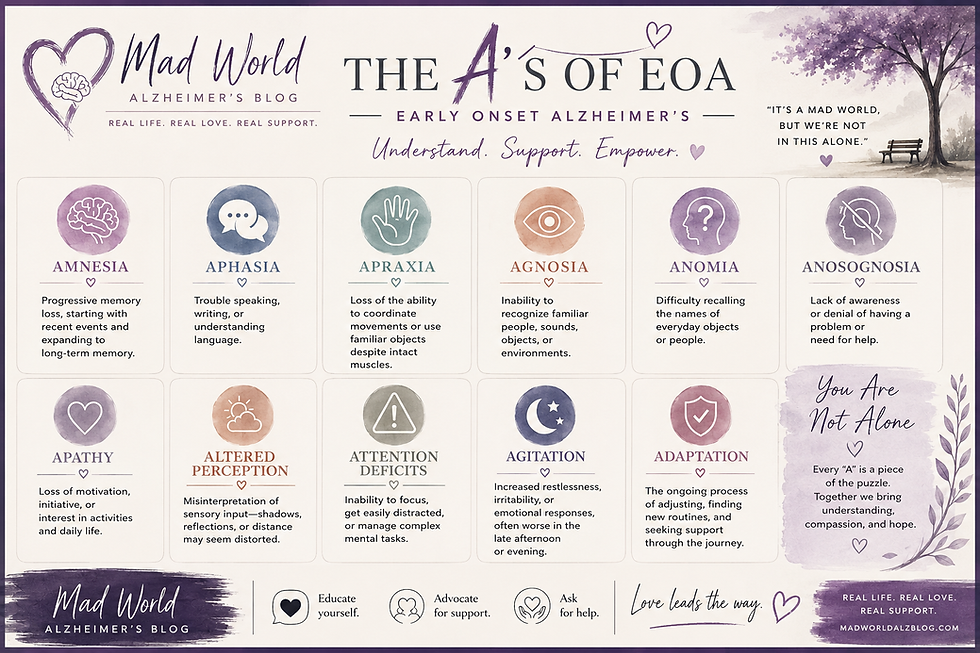
He might say something strange. (aphasia)
Repeat himself.
Behave differently around her friends. (spacial issues)
Not understand a social cue. (insert ackward laugh at something not funny)
Wear something weird. (knee socks and crocs)
Say something too loudly.
And when you're a teenager or young adult, you're already living in a world where you desperately don't want your parents embarrassing you.
Now add Alzheimer's.
I don't think we should shame kids for that reaction.
We should help them understand why Dad is doing it.
😡 Then There Can Be Anger
This one can be brutal.
Why does Dad keep asking me that?
I JUST TOLD YOU.
Why can't he remember?
Why is Mom always taking care of him?
Why can't we go anywhere anymore?
Why can't he drive me?
Why can't he come to my game?
Why is everything about Alzheimer's?
And sometimes:
Why did this happen to MY family?
That's a completely reasonable question.
There isn't a reasonable answer.
😢 And Then Something Else Happens
They start understanding what this really means.
And that's when the sadness can hit.
Not only sadness about what's happening today.
Sadness about what isn't going to happen tomorrow.
Will Dad/Mom remember my graduation?
Will he/she see me get married?
Will he walk me down the aisle?
Will he/she know my husband?
Will he/she meet my babies?
Will he/she know they're his grandchildren?
Will they know me?
Those are enormous things for a young person to carry.
They're grieving someone who is still sitting at the dinner table.
And they're grieving memories that haven't even had the chance to happen yet.
🧠 Kids Need the Truth — But They Need THEIR Version of the Truth
You don't explain Alzheimer's the same way to a 6-year-old that you explain it to a 16-year-old.
👧 Little Kids
Keep it simple.
“Dad has an illness in his brain that makes remembering and doing some things harder.”
They need to know:
Dad didn't catch this because somebody did something wrong.
They didn't cause it.
They can't catch Alzheimer's from him.
And if Dad gets frustrated or says something strange, it's the disease changing how his brain works.
They don't need the entire neurological future today.
They need enough information to understand today.
🧒 Elementary & Middle School Kids
They can understand more.
Explain that Alzheimer's is a disease of the brain and that Dad may gradually need more help.
Talk about things they may actually notice:
“Dad may ask you the same question more than once.”
“He may forget something you told him.”
“Sometimes he may get confused.”
“He might have trouble finding his words.”
And give them permission to say:
“Mom, I need a break.”
They should never feel responsible for keeping their parent safe.
They're children.
Not backup caregivers.
🧑 Teenagers
This is where we were when DX. A teenage daughter, already going through so many hard things at school, with sports, injuries, trying to find a college, friend group drama and then Dad was not right, acting weird, being mean, saying mean things, not making sense, withdrawing from the family and then, threatning to end his life in front of all of us.
Teenagers, I think people forget they are still kids (that look grown) and it's too much to expose them to it all the way. I forget she is not my sounding board.
I also think we sometimes underestimate them.
They already know something is seriously wrong.
Talk to them.
Really talk.
Explain aphasia. Funny my daughter actually learned this and helped with his DX because of his word loss and the Bruce Willis media at the time, thank you Emma and Teepa
Explain behavior changes.
Explain why driving stopped.
Explain why Dad may eventually need help showering or dressing.
Explain that he may someday forget names.
And let them say the ugly things.
“I'm embarrassed.”
“I'm pissed.”
“I hate this.”
“I don't want my friends here.”
“I don't want to deal with him today.”
You don't have to correct every emotion.
An emotion isn't an action.
They're allowed to feel it.
🎓 College Kids & Young Adults
This group gets forgotten.
They're technically adults.
But they're still losing their parent way too early.
They're trying to:
Go to college. (even if it is far away)
Start careers.
Date.
Move away.
Get married.
Build lives.
And they can feel tremendous guilt doing those things while one parent is sick and the other is drowning in caregiving.
Tell them:
GO LIVE.
Take the internship.
Go to college.
Move.
Travel.
Date.
Get married.
Build your career.
Their parent's Alzheimer's should be part of their story.
It should not be allowed to take their entire story.
💜 The Grief Isn't a Straight Line
People love talking about the “stages of grief”:
Denial.
Anger.
Bargaining.
Depression.
Acceptance.
But kids don't neatly graduate from one and move to the next.
Neither do adults.
They may be accepting on Tuesday...
Angry Wednesday...
Embarrassed Friday...
And laughing hysterically with Dad on Saturday.
That's okay.
This is anticipatory grief.
They're grieving losses while their parent is still alive.
And every new loss can start the grieving process all over again.
❤️ But Here's the Other Side
Something beautiful can happen too.
The relationship changes.
My kids aren't interacting with their dad exactly the way they did before Alzheimer's.
But they're finding new ways to love him.
My daughter shaves his beard for him.
Think about that.
A task Dad once did without thinking has become something his child quietly helps him do.
My daughter takes him golfing.
She takes him to the duck park—the place they used to go when she was little.
There's something incredibly bittersweet about that.
Dad took her there.
Now...
she takes Dad.
Not because she's responsible for caring for him.
Because she loves him.
There's a huge difference.
🪒 Give Them Ways to HELP — Not Responsibility
Kids often feel helpless.
Giving them something they choose to do can give them connection.
Maybe it's:
Taking Dad golfing.
Doing a video with them.
Going for a walk.
Playing cards.
Looking through pictures.
Watching their favorite team.
Getting ice cream.
Taking the dog somewhere.
Listening to music.
Doing a simple project.
Letting Dad help THEM with something he can still do.
These don't have to become caregiving duties.
They're opportunities to still have:
Dad/Mom.
📸 MAKE THE MEMORIES NOW
This is one thing I'd tell every younger family.
Stop waiting for the perfect occasion.
Take pictures.
Take video.
Record Dad telling stories.
Record his laugh.
Ask him about his childhood.
Ask how he met Mom.
Ask what he remembers about the kids being born.
Ask what he's proud of.
Have him write something if he still can.
Record messages.
Make photo books.
Take the trip if you can.
Go golfing.
Go to the duck park.
Because someday your child may desperately want to hear their dad's voice saying their name.
Give Future Them that gift while you still can.
🌟 PLEASE KNOW ABOUT LORENZO'S HOUSE
I wish every Early Onset family knew about organizations created specifically for younger families.
Lorenzo's House is one of them.
They focus specifically on families affected by younger-onset dementia.
Their Light CLUBS connect children with other kids who actually understand this bizarre life.
They have groups for:
Ages 4–8
Ages 9–12
Teens 13–17
Young adults 18+
There are also programs for children and young adults whose parent has died after living with younger-onset dementia.
That matters.
Because sometimes the best thing you can give your child isn't another explanation from Mom.
It's another kid saying:
“My dad does that too.”
🧠 Other Places to Get Help
The Alzheimer's Association has specific resources for children and teenagers affected by Alzheimer's, including age-appropriate information, videos and books.
School counselors can help too.
And if you see significant changes such as persistent withdrawal, falling grades, major sleep changes, extreme anger, anxiety, depression or your child simply isn't coping...
Get professional help.
You don't have to wait for a crisis to introduce therapy.
Sometimes having one adult outside the family whom they can say absolutely anything to is invaluable.
💔 What If they Forget Their Name?
I think this is one of the conversations we eventually have to prepare them for.
Someday Dad may not retrieve:
“Alex.”
But that doesn't automatically mean every piece of that relationship disappeared.
He may know:
You're familiar.
I trust you.
You make me feel safe.
I like being with you.
The name may disappear before the feeling does.
So if that day comes, instead of:
“DAD! It's Alex! Don't you know me?”
Try:
“Hey Dad. It's Alex.”
Give him the answer.
Don't make him take the test.
And then go do something together.
❤️ And Please Don't Forget the Healthy Parent
There's another layer to this.
Our kids are watching us too.
They're watching Mom become a caregiver.
They're watching her get tired.
Angry.
Sad.
Overwhelmed.
They're worrying:
Is Mom okay?
Sometimes they're worrying about losing both parents—one to Alzheimer's and the other to caregiving.
That's another reason caregiver self-care isn't selfish.
Our kids need to see that we're still here too.
💜 What I Want My Kids to Know
I wish I could protect them from every part of this.
I can't.
I can't promise their dad will remember every milestone.
I can't promise what he'll understand at their weddings.
I can't promise what relationship he'll have with future grandchildren.
And I certainly can't promise he will always remember their names.
But I can promise them this:
They don't have to stop living because Dad got Alzheimer's.
They can be embarrassed.
They can be angry.
They can be sad.
They can laugh.
They can leave.
They can come home.
They can help.
They can say “I can't today.”
And none of those things changes how much they love their dad.
Because Early Onset Alzheimer's didn't happen only to him.
In a way...
It happened to all of us.
We're just each losing something different.
💜 Caregiver Question
How old were your children when their parent was diagnosed?
What emotion came first—fear, embarrassment, anger, sadness?
And what have they found that they can still do with Mom or Dad that belongs just to them?
Sometimes another parent needs to hear that idea.
📚 Resources
Lorenzo's House — Younger-onset dementia support specifically for children, teens, young adults and families.
Alzheimer's Association — Resources for talking to children and teenagers about Alzheimer's and dementia.
National Institute on Aging — Guidance for helping children understand Alzheimer's and cope with changes in someone they love.
Facebook Groups for Kids of EOA/Alzheimer's
💬 Disclaimer
Keep in mind, I am writing this blog over years, not in one day- I repeat some things, but because it became more applicable today. I’m not a doctor, lawyer, therapist, or expert—just a wife trying to figure this out one day at a time. Everything shared here is based on our experience and things that have helped us along the way. Take what helps, leave what doesn’t, and always check with professionals when needed. I also use AI to help clean up my writing, organize thoughts, and pull together resources because honestly… caregiver brains are tired too. If something here helps another family feel less alone, then it’s worth sharing.

Comments