🎵 “Bad Day” – EOA not every day is a good day (Daniel Powter)
Updated: Oct 4
If you live with Alzheimer's long enough, you start becoming a little bit of a dementia meteorologist.
You wake up, look at your person and think:
Ohhhhhhh. We're gonna have weather today.
😂
I can usually tell pretty quickly.
Did he get up around 8:00 AM?
Fresh.
Happy.
Moving.
Talking relatively well.
Ready to eat and start his day?
We're looking pretty good.
OR...
Did he slow-roll out of bed around 10:00?
Hair everywhere.
Groggy.
Walking around confused.
Not quite sure what he's supposed to be doing.
And...Spitting bars.
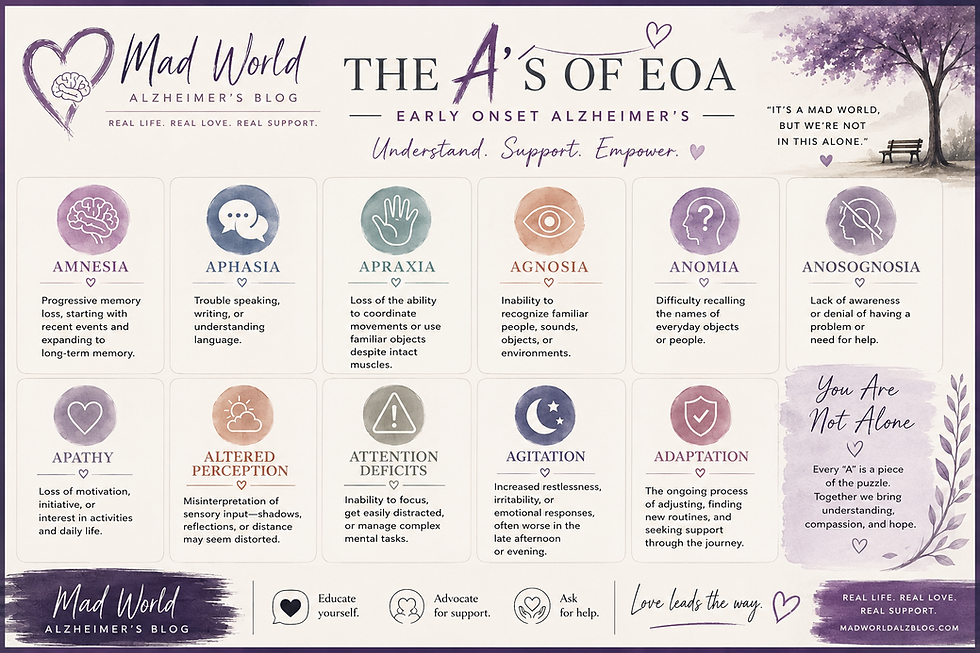
That's what I call those mornings when the aphasia is aphasia-ing and we're getting words—but they're coming out like somebody threw the English language into a blender.
There are words.
There are sentences.
There is tremendous enthusiasm.
There is absolutely no fucking clue what we're talking about.
And that's when I know:
Okay. Today may be a bad day.
🧠 What IS a Bad Alzheimer's Day?
I think that answer depends enormously on:
What stage you're in.
And, frankly...
How much patience YOU have that day.
A bad day earlier in the disease may look like:
More trouble finding words.
More repetitive questions.
More confusion.
Losing things.
Difficulty following directions.
Being unusually quiet.
Irritability.
Anxiety.
Getting overwhelmed more easily.
As Alzheimer's progresses, a bad day may mean something entirely different:
More trouble dressing.
Difficulty showering.
More agitation.
More wandering.
More resistance to help.
Problems recognizing things.
Incontinence issues.
More difficulty communicating.
Sleepiness.
Or simply seeming much farther away than they did yesterday.
But there's something important I've learned:
Not every bad day means we've permanently declined.
Sometimes...
It's just a bad fucking day.
🌅 For Me, The Morning Tells Me A LOT
I've learned not to ignore what I see first thing.
If Rob wakes up rested, moving well and communicating relatively normally for him...
I feel much better about the day.
But when he wakes late, groggy, confused and significantly more aphasic?
I adjust.
I don't immediately think:
OH MY GOD. WE'VE ENTERED ANOTHER STAGE.
Instead I think:
What happened yesterday?
🕵️ Time for Alzheimer's CSI
Did he sleep well?
Did he wake repeatedly?
Did he have vivid dreams?
Did he go to bed late?
Did he eat late?
Did he take a huge nap yesterday?
Did he exercise?
Did he get enough activity?
Did he drink enough water?
Is he constipated?
Is he getting sick?
Did something change with his medications?
Was yesterday overstimulating?
Did we have a big outing?
Was he around a ton of people?
Was there too much noise?
Did he simply have to work his brain too damn hard?
Because Alzheimer's doesn't exist separately from the rest of the body.
😴 SLEEP CAN SCREW UP EVERYTHING
Sleep matters in our house.
And medications can matter too.
For us, Aricept/donepezil has been associated with very vivid dreams.
That's a known potential side effect of donepezil, along with sleep disturbance in some people. Also a very low heart rate comes with this pill if your loved one wears a health band, apple watch or Oura ring, it will flip you out.
So if sleep suddenly changes after starting a medication or changing when it's taken, tell the prescriber rather than changing the dose or schedule yourself.
Sometimes the doctor may have recommendations about medication timing.
But sometimes the explanation is simpler:
They had a shitty night's sleep.
Think about yourself after sleeping terribly.
You're slower.
You're cranky.
You can't concentrate.
You forget things.
You don't want anybody talking to you.
Now put Alzheimer's on top of that.
Exactly.
🧠 Their Brain Gets Tired
This is something I wish I understood earlier.
Things that look easy to me may require a tremendous amount of cognitive work for him.
Following a conversation.
Figuring out what someone said.
Finding the right word.
Getting dressed.
Navigating a restaurant.
Processing noise.
Following directions.
Recognizing where we are.
Remembering what we're doing.
Responding appropriately.
His brain is constantly trying to compensate for things that used to happen automatically.
So sometimes after a busy day, I see it.
He's done.
The words get worse.
Confusion increases.
Patience disappears.
Everything gets harder.
And that's when adding MORE stimulation isn't necessarily going to fix anything.
🏠 So What Do I Do on a Bad Day?
Usually?
I LOWER THE BAR.
Wayyyyy down.
😂
If we had optional plans?
Maybe we cancel.
If I was thinking about taking him somewhere crowded?
Not today.
If we're supposed to run five errands?
Maybe we don't.
If someone wants us to meet at a loud restaurant?
Rain check.
And I've stopped feeling guilty about it.
Because I'd rather disappoint someone by cancelling lunch than push him through an environment his brain clearly isn't handling well that day.
🚗 Sometimes Staying Home IS the Activity
There's this pressure as a caregiver to keep them:
Active!
Social!
Stimulated!
Engaged!
Exercising!
Doing brain games!
Living normally!
All wonderful things.
But sometimes the best thing I can do is recognize:
Today isn't the day.
Home.
Familiar surroundings.
Comfortable clothes.
Simple food.
Water.
Music.
A familiar television show.
Maybe a walk.
Maybe some light exercise if he's up for it.
Maybe watering plants.
Maybe absolutely nothing.
There doesn't need to be a dementia enrichment curriculum every afternoon.
Sometimes the brain needs a break.
🚫 DON'T FORCE THE ORIGINAL PLAN
This has probably been one of my bigger lessons.
Before Alzheimer's, if we made plans...
we did the plans.
Now?
I have to be willing to pivot.
Because if he's already confused at home, taking him somewhere unfamiliar, noisy or chaotic may make everything worse.
And then I'm trying to manage:
Him.
The environment.
Other people.
Bathrooms.
Food.
Directions.
Transportation.
His anxiety.
My anxiety.
Why am I doing this to us?
Sometimes cancelling isn't Alzheimer's winning.
It's me reading the room.
💜 AND SOMETIMES I'M THE BAD DAY
Let's be fair.
😂
There are mornings when Rob isn't dramatically worse.
I'm just done.
Maybe I didn't sleep.
Maybe work is crazy.
Maybe I'm hormonal.
Maybe I've answered the same question 14 times.
Maybe yesterday sucked.
Maybe I've got absolutely nothing left in the caregiver patience tank.
That matters too.
Because a behavior I can redirect calmly on Monday might make me want to launch myself directly through a window on Thursday.
That's another reason I think the definition of a “bad day” depends partly on the caregiver.
Sometimes he needs less stimulation.
Sometimes I do too.
⚠️ BUT DON'T CALL EVERYTHING “A BAD ALZHEIMER'S DAY”
This part is really important.
If your person is suddenly and dramatically different from their normal baseline, don't automatically shrug and say:
“Alzheimer's.”
A sudden change in confusion or behavior can have another medical cause.
Things such as:
Infection.
Medication problems.
Dehydration.
Pain.
Constipation or urinary problems.
Low oxygen.
Blood-sugar or metabolic problems.
Stroke.
Seizure.
Other acute illness.
Dementia usually progresses over time.
A sudden major change deserves attention.
If something feels substantially different, call the healthcare team.
And obvious emergency symptoms—new facial droop, one-sided weakness, sudden severe speech change, loss of consciousness, serious breathing problems, a first seizure or another acute neurological emergency—mean emergency care, not “let's see how tomorrow goes.”
📓 START LOOKING FOR PATTERNS
This can be surprisingly useful.
You don't need some elaborate Alzheimer's spreadsheet.
Just keep notes.
Bad morning. Slept terribly.
Great day. Worked out yesterday.
Very confused after big family dinner.
Aphasia worse after long nap.
Agitated after crowded restaurant.
Up three times overnight. Rough morning.
After a while, you may start seeing patterns.
Not everything will have an explanation.
This is Alzheimer's.
Sometimes the answer will simply be:
His brain had a bad day.
But if I can identify things that consistently make life easier?
I'll take every advantage I can get.
❤️ A BAD DAY DOESN'T ALWAYS MEAN A NEW STAGE
Knowing your person's baseline of skills is how you judge, if this is consistant over several days, it may be a decline.
This may be the most important thing I remind myself.
When you're constantly watching someone decline, every bad day can feel terrifying.
Is this the new normal?
Did we just lose something else?
Are we moving into another stage?
And sometimes tomorrow morning...
He gets up.
He's smiling.
He's talking better.
He's ready to go.
And I think:
Oh. There you are.
That's Alzheimer's too.
Function can fluctuate.
One rough day doesn't necessarily establish a permanent new baseline.
I watch.
I adjust.
And if the change persists or worries me, I involve his medical team.
🎵 Why “Bad Day”
Because sometimes Alzheimer's doesn't need a deeper explanation.
Sometimes yesterday was too much.
Sometimes they didn't sleep.
Sometimes their routine got screwed up.
Sometimes their brain is tired.
Sometimes they're overstimulated.
Sometimes something medical needs attention.
And sometimes...
It's just a bad day.
I've learned I don't have to rescue every one of them.
I don't have to force him through the itinerary.
I don't have to prove that we're still living our normal life.
I can cancel.
I can simplify.
I can shut the world out for a day.
I can put food in front of him, get some water into him, turn on something familiar and let his brain rest.
Tomorrow we'll try again.
Because Alzheimer's asks enough from both of us already.
We don't have to make the bad days harder than they need to be.
💜 CAREGIVER CHECK-IN
Can you tell first thing in the morning what kind of day you're going to have?
And have you figured out your person's triggers?
Do you know their baseline?
Sleep?
Too much activity?
Crowds?
Long naps?
Changes in routine?
Medication timing?
Not eating or drinking enough?
Start paying attention.
You may not be able to control Alzheimer's.
But sometimes you can control the day around it.
💬 DISCLAIMER
Keep in mind, I am writing this blog over years, not in one day- I repeat some things, but because it became more applicable today. I’m not a doctor, lawyer, therapist, or expert—just a wife trying to figure this out one day at a time. Everything shared here is based on our experience and things that have helped us along the way. Take what helps, leave what doesn’t, and always check with professionals when needed. I also use AI to help clean up my writing, organize thoughts, and pull together resources because honestly… caregiver brains are tired too. If something here helps another family feel less alone, then it’s worth sharing.
Comments