🎵 “Changes” – EOA Changes in Behaviors(David Bowie)

Some days, this disease feels like living in two realities.
There is the person you see:
Your spouse
Your best friend
The person who looks healthy
The person who still smiles
The person who can remember something random from 1987
And then there is the disease.
The repeating.The arguing.The made-up memories.The “you took my independence.”The “I can drive.”The “there’s nothing wrong with me.”The “you’re the problem, not me.”
And you stand there thinking:
👉 What is actually happening inside their brain?
🧠 The Simple Version: Alzheimer’s Changes the Brain Before We See It
Alzheimer’s is not just “forgetfulness.” It is a progressive brain disease.
Experts describe Alzheimer’s as involving abnormal buildup of proteins—especially beta-amyloid plaques and tau tangles—that disrupt brain cell communication, damage neurons, and eventually cause brain tissue to shrink over time.
So when your spouse repeats something 12 times, insists something happened that never happened, or believes they can do something safely when they cannot…
👉 It is not always stubbornness.
👉 It is brain change.
🧩 Why They Repeat Over and Over (and over, over, over)
Repetition often happens because short-term memory is not “sticking.”
They may ask:
“Where are we going?”
“What time is dinner?”
“Why can’t I drive?”
“Who is coming over?”
And then ask again five minutes later.
Why?
Because the answer may not store properly. The hippocampus and connected memory networks are commonly affected early in Alzheimer’s, which impacts new learning and recent memory.
So they are not trying to irritate you.
Their brain is treating the question like it is new every time.
🚗 “You Took My Driving Away”
This one hurts.
They may say:
👉 “You stopped me from driving.”
👉 “You took my independence.”
👉 “I can drive fine.”
And you want to scream:
👉 “I am trying to keep you alive.”
But insight and judgment are also brain functions. Alzheimer’s can damage reasoning, judgment, problem-solving, and awareness. Younger-onset Alzheimer’s can be especially likely to show non-memory symptoms early, including judgment/problem-solving, language, visuospatial problems, and behavior changes.
So when they cannot see the risk, it may be because the brain system that should recognize the risk is damaged.
That does not make it easier.
But it does help you stop taking every argument personally.
🧠 “I Remember That Perfectly” — But It Never Happened
This one is wild.
They may remember something from childhood in detail.
Then five minutes later, they may tell a story that never happened.
Or mix three memories together and present it as fact.
This can happen because memory is not a perfect recording system even in healthy brains. In Alzheimer’s, damaged memory networks may leave gaps, and the brain can try to fill those gaps.
To the person with dementia, it may feel completely true.
So arguing usually does not help.
Instead of:
❌ “That never happened.”
Try:
✔️ “That sounds like it feels really real to you.”
✔️ “I hear you.”
✔️ Redirect if it is causing distress.
🗣️ Why the Words Change
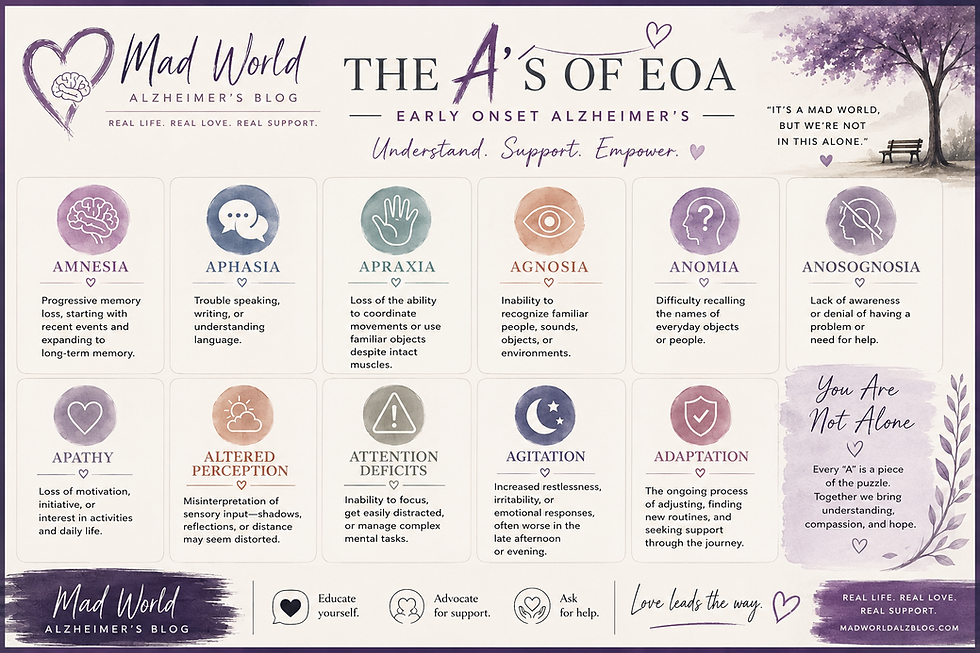
In younger-onset dementia, symptoms may not start with memory. They may start with language, vision/perception, behavior, planning, or coordination. Alzheimer’s Society notes that younger people with dementia are less likely than older adults to have memory loss as the first symptom and may instead have problems with language, vision, behavior, movement, balance, or coordination.
That explains why Early Onset can look so different.
The disease may affect:
Language networks → word loss, aphasia, word salad
Visual-spatial areas → depth perception, driving trouble, getting lost
Frontal/executive networks → judgment, impulse control, planning
Memory networks → recent memory, repeated questions
So no, you are not crazy.
This disease can attack different skills at different times.
👁️ Why “Common Sense” Starts Disappearing
This is one of the most painful changes.
They may not know:
What to wear for the weather
When to come inside from heat
How much food is too much
That metal does not go in the microwave
How to sequence a shower
Why driving is unsafe
That is not laziness.
That is loss of executive function.
Executive function is the brain’s ability to plan, sequence, judge, stop, start, organize, and make decisions. Early-onset Alzheimer’s can include problems with organization,
communication, judgment, and visuospatial tasks—not just memory.
This is why Stage 5 can feel like you are managing an adult body with a childlike level of judgment.
And that realization is devastating.
🌙 Why It Gets Worse at Night
If symptoms get worse later in the day, that may be sundowning.
The brain gets tired. The environment changes. Light changes. Routine shifts. They may become more anxious, more confused, more repetitive, or more agitated.
So at 7 p.m., you may suddenly see:
Pacing
Fridge opening
Mumbling
Restlessness
Confusion
Irritability
This is not “bad behavior.”
It is a tired, damaged brain trying to make sense of the world.
💡 What Can Naturally Help Stimulate the Brain?
Let me be clear:
👉 Nothing natural has been proven to cure Alzheimer’s.
👉 Supplements and activities do not reverse the disease.
But certain lifestyle supports may help quality of life, mood, function, and overall brain health.
Movement
Physical activity is one of the strongest “common sense” supports. It may help blood flow, mood, sleep, anxiety, strength, and routine. A recent long-term study reported that walking more steps was associated with slower cognitive decline and slower tau buildup in at-risk adults, though this does not prove exercise cures Alzheimer’s.
For us, biking and movement matter.
Not because it fixes him.
Because it keeps him engaged, calmer, stronger, and more himself.
Routine
Routine reduces anxiety. Same meals, same exercise, same bedtime, same expectations.
Routine becomes a safety rail for a brain that cannot adapt like it used to.
Music
Music can reach emotion even when words fail. It can cue memory, calm anxiety, and create connection.
Sometimes a song gives you a glimpse.
Sometimes it breaks you.
Both are true.
Social Engagement
Talking, walking, shopping, simple tasks, games, and familiar people can help keep skills active longer.
Not overwhelming social events.
Just gentle engagement.
Practice the Skills That Matter
We practice:
Phone use
Emergency calls
Names
Directions
Hygiene routines
Gym exercises
Safe habits
Because muscle memory and repeated routines often last longer than new learning.
🧠 What Changes Across Stages?
Every person is different, but generally:
Early Stage / MCI to Stage 3
You may see:
Word finding problems
Anxiety
Work struggles
Subtle judgment changes
Social withdrawal
Trouble with planning
Stage 4
You may see:
Trouble with finances
Difficulty cooking, driving, shopping
Repeated questions
Denial or lack of insight
Social withdrawal
Stage 5
You may see:
Cannot safely live without guidance
Confusion about clothes, meals, hygiene
Poor judgment
Increased vulnerability to scams/safety issues
Needs reminders and supervision
Stage 6–7
You may see:
More help with dressing, bathing, toileting, eating
More agitation or wandering
Less speech
More physical decline
Full-time care needs
This is why caregiving keeps changing.
You are not doing the same job for 10 years.
You are constantly learning a new version of the disease.
🎵 Why “Changes”
Because that is what this disease is.
Changes in memory.
Changes in words.
Changes in judgment.
Changes in independence.
Changes in personality.
Changes in your marriage.
Changes in your future.
And the cruel part?
They may not understand the changes the same way you do.
You are watching them leave slowly.
They are often just trying to get through the moment.
💭 Final Thought
When they repeat, argue, deny, misremember, or insist they are fine…
try to remember:
👉 There is a brain under attack in there.
👉 There is fear in there.
👉 There is confusion in there.
👉 And there is still a person you love in there.
You cannot stop every change.
But you can learn what is happening, adapt the environment, keep them engaged, protect safety, and stop blaming yourself for what the disease is doing.
Helpful Resources
National Institute on Aging: What Happens to the Brain in Alzheimer’s Disease
Mayo Clinic: Alzheimer’s Symptoms and Causes
Alzheimer’s Society: Young-Onset Dementia
Alzheimer’s Research UK: Young-Onset Dementia Symptoms
Johns Hopkins: Early-Onset Alzheimer Disease
💬 Disclaimer
Keep in mind, I am writing this blog over years, not in one day- I repeat some things, but because it became more applicable today. I’m not a doctor, lawyer, therapist, or expert—just a wife trying to figure this out one day at a time. Everything shared here is based on our experience and things that have helped us along the way. Take what helps, leave what doesn’t, and always check with professionals when needed. I also use AI to help clean up my writing, organize thoughts, and pull together resources because honestly… caregiver brains are tired too. If something here helps another family feel less alone, then it’s worth sharing.
What did you see first?
Word Loss
Memory Issues
Losing items
Forgetfullness on a lot of things

Comments